Choosing between OpenCode and Claude Code
I care a lot about open source, picking my own model, and not being locked into one vendor’s stack. That bias shapes how I compare these two ways of running Claude Opus (and other models) against your repo and shell.
Both let you chat with the codebase and run terminal work; the difference is mostly who owns the knobs—you, or a tightly integrated product.
How I slice it: OpenCode vs. Claude Code (with Opus when applicable)
| OpenCode | Claude Code | |
|---|---|---|
| What it optimizes for | Horizontal flexibility: UI and model are decoupled; lots of providers (75+). | Vertical polish: tuned for Anthropic’s models and tooling. |
| Model choice | Swap mid-session—e.g. Opus for planning, something cheaper for boilerplate—or free tiers on aggregators. | Claude-only in practice (Haiku / Sonnet / Opus). |
| Where you live | Desktop, web, and a busy TUI with modes/tabs. | A very polished CLI that feels “native” to Claude. |
| Agents | YAML / markdown agents you wire yourself—powerful, more setup. | Built-in subagents (Plan, Explore, Task) that just work. |
| Undo story | Plain Git for /undo (repo must be Git). | Snapshots (Esc twice)—fast, proprietary. |
| What I’ve noticed | Often more thorough, more tests generated. | Often faster (~45% in some comparisons) and strong on benchmarks like SWE-bench Pro. |
What I actually prefer
- Open source—I like tools I can read, fork, and reason about.
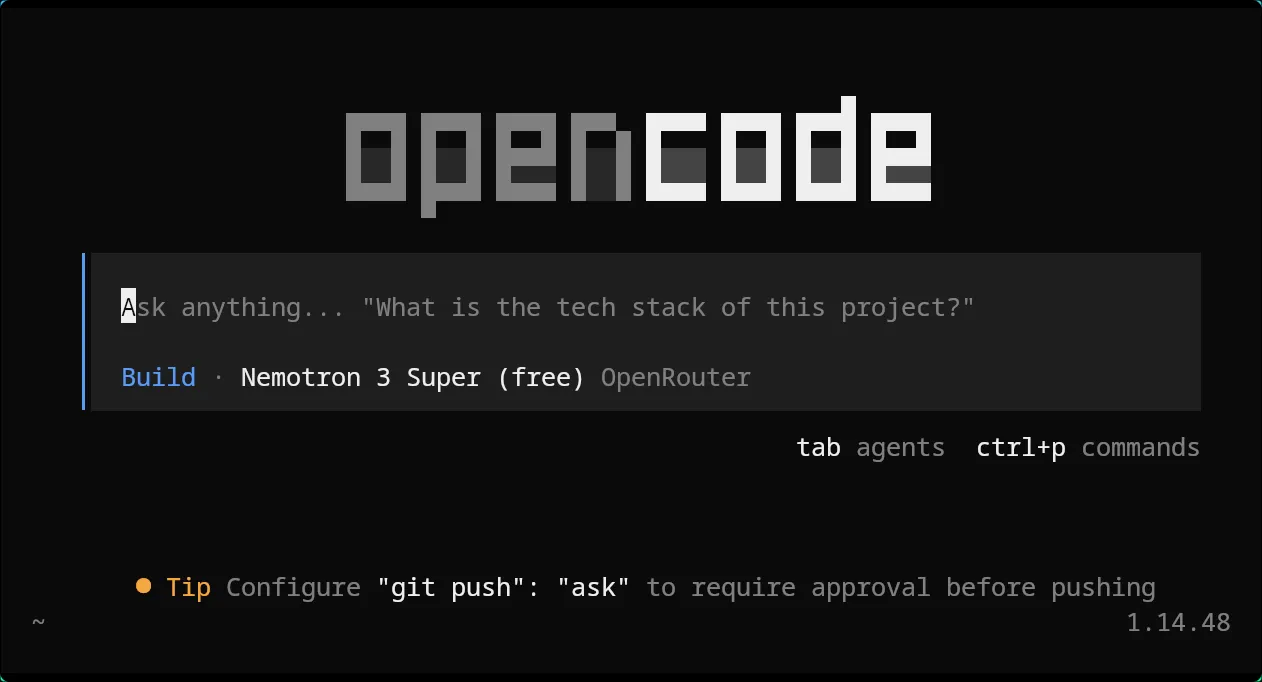
- Decoupled model so I can chase free or cheap options when I want—e.g. NVIDIA Nemotron 3 Super on OpenRouter (free tier)—not only Opus.
- Git-native flow: versions live in normal Git, not only in an app-specific checkpoint format.
I’ll be honest: my time in Claude Code has been great—it handles repos and multi-file edits in a way that feels effortless. I’m not trying to bring it down. So far it’s the best; I’m explaining why I still lean OpenCode for day-to-day philosophy.
When OpenCode wins for me
- Hybrid cost: Opus (or similar) for hard bits, then switch down for repetitive churn.
- Agents & skills as markdown/ YAML in my repo—matches how I already document habits.
- Remote / server: client–server layout is handy for Docker or driving a session from another box via HTTP.
When I’d still grab Claude Code
- Tight Claude integration: tool use and context often feel more predictable without me tuning YAML.
- Subscription math: if you’re already on Pro/ Max, the CLI can beat pay-per-token through a generic client.
- Low-friction experiments: snapshots beat “commit everything” when I’m spiking and don’t want Git noise yet.