OpenCode v1.18.34.
Where a coding-agent session goes when the window closes: how opencode -c resumes it, why the accumulated store is a business data asset at team or org scale (§2), where the bytes live, what can be reused, when to purge, and how to back it up.
1. What a session is, and what -c resumes
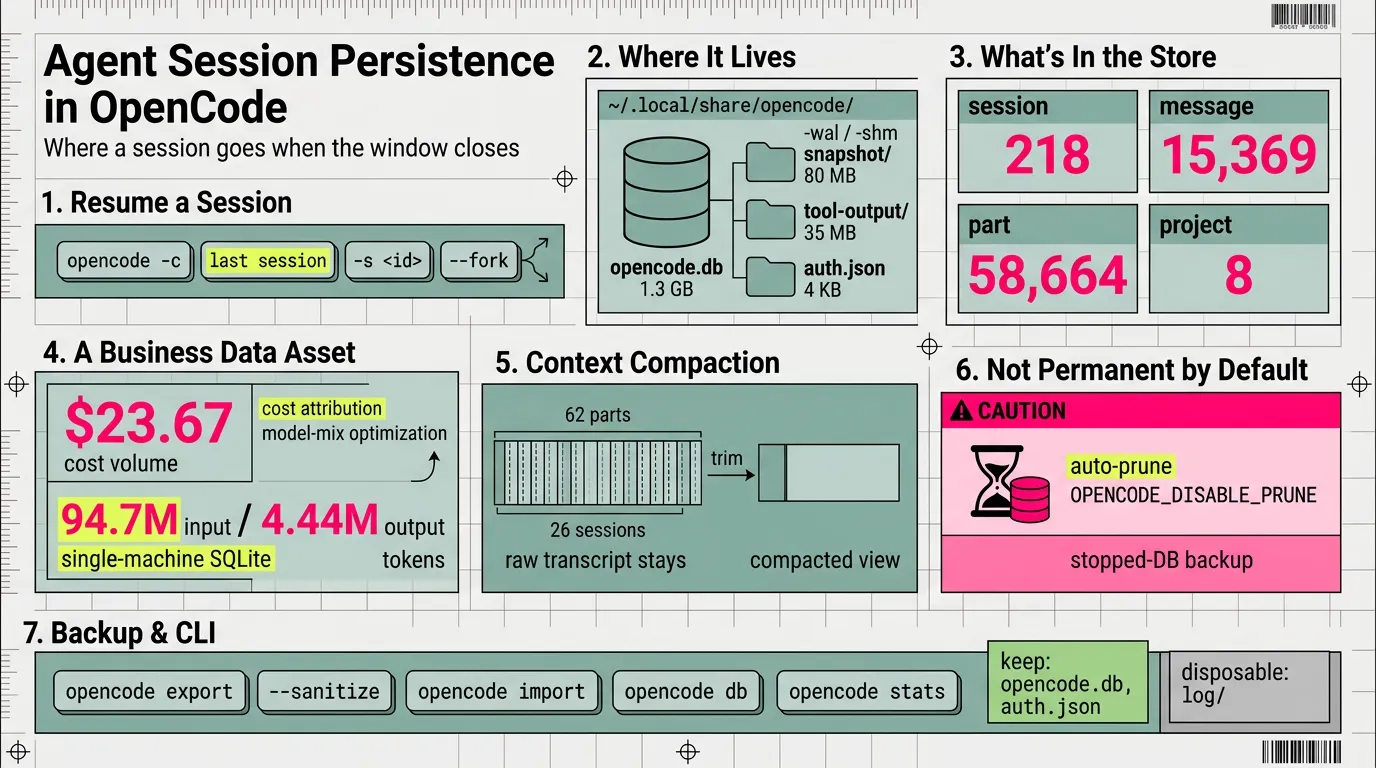
A session in OpenCode is one conversation thread: an ordered list of messages, each split into typed parts. The verified part types are text, tool, reasoning, step-start, step-finish, patch, file, compaction, and agent, and messages themselves carry only the user and assistant roles. opencode -c (or opencode --continue) resumes the last session; -s <id> / opencode --session <id> resumes a specific one. The help text does not say whether “last” is scoped to the current project, so that stays an open question. --fork copies the session into a new one before continuing, leaving the original intact, and the mini interface can cap or disable the history replay with --replay-limit and --no-replay — mini/TUI flags that are not on the main CLI page.
2. The stored session log as a business data asset (team / org)
Persistence is not only “resume my chat.” At team scale the database is a structured, queryable record of work — and that is where much of its value sits.
On this machine, as of 2026-10-04, the store held 218 sessions, every one carrying model and agent, of which 132 had a non-zero cost; the log totalled $23.67 over 94.7M input / 4.44M output tokens. Those figures come from columns session already maintains — cost, tokens_input/output/reasoning/cache_read/cache_write — alongside time_created/time_updated, project_id, agent, and model (stored as JSON with id, providerID, and variant). Because the data is already structured, cost attribution and chargeback need no transcript parsing:
SELECT p.worktree,
       json_extract(s.model,'$.id') AS model,
       COUNT(*)                     AS sessions,
       ROUND(SUM(s.cost), 2)        AS cost_usd,
       SUM(s.tokens_input + s.tokens_output) AS tokens
FROM session s JOIN project p ON p.id = s.project_id
GROUP BY p.worktree, model ORDER BY cost_usd DESC;
That rollup is the basis for showback and chargeback, for budget alerts, and for spotting where a cheaper model would do (model-mix optimization). Session counts and token volume per project also show which workflows the agent actually accelerates — and which are heavy for little return. The transcript is a forensic trail too (the exact command, timestamp, and triggering message), as used in the persona/scratch-artifact postmortem. And messages and parts are a corpus of real problem→solution pairs; semantically indexed (§11), they become an internal knowledge base or onboarding material.
The realistic gap is aggregation: this is a per-user, single-machine SQLite file with no built-in cross-developer or cross-machine rollup. True org analytics means collecting these stores (or opencode export dumps) into a warehouse — Postgres/pgvector, BigQuery, and so on — which is a project, not a feature. The counterweight is sensitivity: the same data holds source, secrets, and customer context, so retention, access control, and redaction are prerequisites, not afterthoughts; --sanitize is not a ZDR or privacy guarantee — see 260927-opencode-openrouter-model-selection.md.
3. Where it is stored
Everything lives under the XDG data dir, ~/.local/share/opencode/ (the path prints from opencode db path). The store is a single SQLite database, not a directory-per-session: opencode.db, plus its -wal and -shm sidecars. On this machine opencode.db measured 1.3 GB, with log/ at 28 MB, snapshot/ at 80 MB, tool-output/ at 35 MB, and auth.json at 4 KB (mode 600). Persistence is not permanent by default: OpenCode prunes old data unless OPENCODE_DISABLE_PRUNE is set, so older sessions can be reaped automatically, and OPENCODE_DISABLE_AUTOCOMPACT likewise turns off automatic compaction (§6).
4. Directory and schema structure
opencode.db holds sessions, messages, parts, todos, shares, permissions, projects, credentials, and events. Beside it, snapshot/<project-id>/ is one git snapshot repository per project — the top-level directory names match project.id — which appears to power revert (inferred), with a nested path-hash level under global/. tool-output/ holds large tool results spilled to disk (files named tool_<id>) and referenced by parts; log/ holds runtime logs (rotation unverified); and auth.json holds provider credentials, a secret to be neither printed nor committed.
The key tables, verified with counts as of 2026-10-04, are session (218 rows), message (15,369), part (58,664), and project (8), plus todo, session_share, session_context_epoch, permission, workspace, credential, and event. A session row carries project_id, workspace_id, parent_id (for forks and child sessions), slug, directory, path, title, version, the token and cost counters, revert, and time_archived. Both message and part store their payload as a data JSON blob keyed to session_id, which is why an ad-hoc SQL query can reconstruct a full transcript. The schema is internal and unstable, so do not build tooling on it without pinning the OpenCode version.
5. How resume works (mechanism)
On startup, OpenCode resolves the project (by worktree) from the project table, picks the session, loads its messages and parts in time_created order, and rebuilds the model context — though that is inferred rather than read from source, as is the on-demand re-hydration of attachments, snapshots, and spilled tool-output. State scoping, by contrast, is verified: todo rows are session-scoped and die with the session, while permission rows are keyed by project_id, so an “always” approval persists across sessions in that project (see 260811-agents-opencode-config.md); durable rules live in config and AGENTS.md (see 260821-agents-md-not-a-persona.md). The DB is also the forensic record — the exact command, timestamp, and triggering user message — which is the trail used in the persona/scratch-artifact postmortem.
6. Context compaction (long sessions)
A long session eventually exceeds the model’s context window, so the agent compacts: it summarises and trims the history so the same thread can keep going. The store shows compaction at work — part rows of type compaction numbered 62, spread across 26 sessions on this machine, plus a session.time_compacting timestamp column and a session_context_epoch table (present but empty here; its exact role is inferred). This matters for persistence because the raw transcript stays in the DB, while what the model sees on resume is the compacted view: persistence preserves the record, compaction reshapes the working context.
7. What else you can do (CLI surface)
Beyond resuming, the CLI can manage and move sessions. opencode session list lists them, and opencode session delete <id> removes one. opencode export [sessionID] writes a session to JSON, and --sanitize redacts sensitive transcript and file data; opencode import <file|url> restores a session from that JSON or from a share URL. opencode db runs a SQL query against the store, and opencode stats reports token and cost aggregates (--models, --project, and --days break them down). Sharing has no standalone opencode share command — it is done via opencode run --share, the OPENCODE_AUTO_SHARE env var, or the TUI, and the resulting link is recorded in the session_share table.
8. Reuse: when a session helps, and when to start fresh
A session helps when you are continuing a long task, resuming after a crash, or forking to try an alternative without losing the original. It hurts when the work is unrelated: stale history inflates the context and dilutes the prompt, so the rule is “new task → new session.” Forking is the cheap way to branch a decision tree, and the original remains the record.
9. When you can ignore it
Some sessions are not worth keeping: read-only Q&A threads with nothing to preserve, or sessions whose value you have already codified into AGENTS.md or a SKILL.md — the durable artifact is the file, not the transcript. After opencode session delete (which cascades to messages and parts via foreign keys), nothing should remain; verify.
10. Backup — what matters and what is disposable
Keep auth.json (the credentials) and opencode.db (the history). Because old data can be pruned automatically (§3), a copy of the DB taken while OpenCode is stopped is the only durable whole-history backup; per-session exports cover only the sessions you chose to keep. log/ is disposable, while tool-output/ and snapshot/ are large but should not be casually deleted — the spilled tool results are referenced by parts, and the snapshots are git repositories that capture past states for revert and do not regenerate. Backup, then, splits by intent: opencode export <id> (optionally --sanitize) to share or archive a single session, or a stopped-DB copy for a full backup (SQLite’s WAL can make a live file copy inconsistent — untested here), since no bulk-export command is documented. This mirrors the Hermes pattern in 260528-hermes-backup.md — config, sessions, and auth as the essentials.
11. Optional: vectorization / semantic index over history
The DB is a searchable transcript store, and the obvious extension is to embed messages and parts for semantic search. A local route would be sqlite-vec or FTS5, but the DB is app-owned and open under WAL, so attaching extensions is untested and could conflict with OpenCode; Supabase (pgvector) is the hosted route. The risk is cost and privacy — indexing history means shipping or embedding source and secrets.
Open questions
- Does
log/rotate? - Does share/export include file contents and tool output by default?
- Is there a supported bulk export/backup, or is it per-session only?
- How much context/token replay does
-cincur on a large session? - Which session does
-cpick when multiple projects share a directory? - What does compaction keep versus drop, and is dropped context recoverable?
- What does automatic pruning remove, and on what schedule or retention window?
Verification commands
opencode --version
opencode db path
opencode session list
du -sh ~/.local/share/opencode/*
sqlite3 "file:$HOME/.local/share/opencode/opencode.db?mode=ro" \
  "SELECT 'session',COUNT(*) FROM session UNION ALL SELECT 'message',COUNT(*) FROM message;"
Glossary
- ZDR — Zero Data Retention: the provider discards prompts and completions after each request (a retention guarantee, distinct from opting out of training).
- WAL — SQLite’s Write-Ahead Log (
opencode.db-wal), a sidecar holding recent changes before they are checkpointed. - XDG — the freedesktop base-directory convention (
~/.local/share,~/.config, …). - DB — database; here, the SQLite file
opencode.db. - CLI — command-line interface; TUI — the terminal user interface (
opencodewith no arguments). - JSON — JavaScript Object Notation; the text format OpenCode stores message/part payloads in.
- SQL — Structured Query Language; FTS5 is SQLite’s full-text-search extension.
- pgvector / sqlite-vec — vector-embedding extensions for Postgres and SQLite.
Sources
- OpenCode v1.18.34 CLI help:
opencode --help,opencode session --help,opencode export --help,opencode import --help,opencode db --help,opencode stats --help(retrieved 2026-10-04). - Live SQLite schema:
opencode db path→~/.local/share/opencode/opencode.db. - Cross-links:
260811-agents-opencode-config.md,260821-agents-md-not-a-persona.md,260528-hermes-backup.md,260927-opencode-openrouter-model-selection.md.
btw, i use arch