2026-10-22
Thesis: The model is the least interesting part of the stack. What comes out of a session is decided mostly by the loop an agent runs around the model — and that loop is only as good as the instruction it was given. The real skill is not technical. It is saying precisely what you want.
This is not a survey. It is one person’s experience after about a year of heavy use, and the only measurements in it are my own.
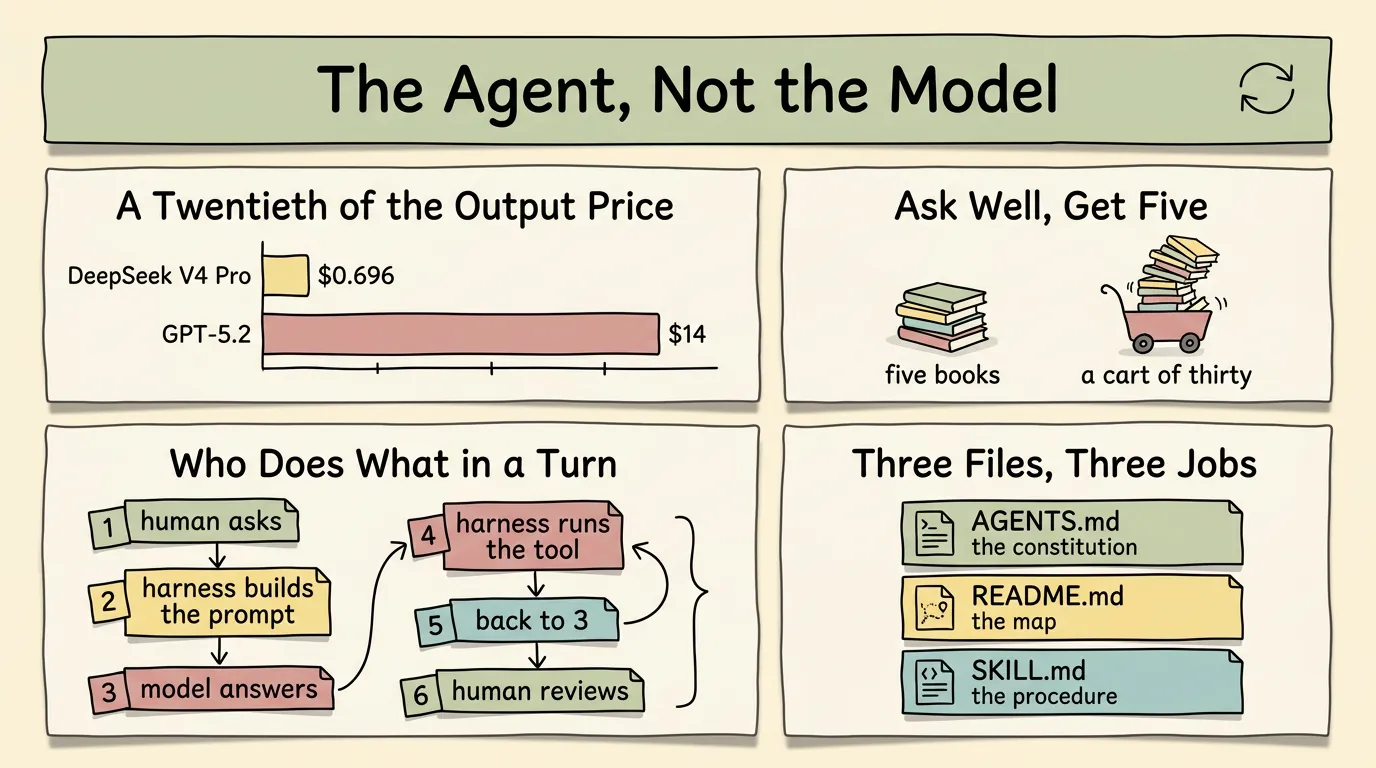
The bottleneck isn’t the model
Hundreds, maybe thousands of models now sit in the catalogues: free ones, paid ones, confusing ones. Claude, OpenAI and Google are probably still the top three… maybe. New entrants keep arriving with a chart that says they won something.
The chart has little to do with my work. I write articles, code, review and analyze code, and keep repositories organized. None of it is very complex; all of it needs to be logical and precise. So: benchmark performance is mostly marketing — a way to attract attention and investment. That is not a claim that benchmarks measure nothing. They measure something. It just isn’t the thing I’m paid for.
The practical version: a cheaper model does not much degrade the output, for work like mine. DeepSeek V4 Pro costs $0.348 / $0.696 per million input / output tokens; GPT-5.2 costs $1.75 / $14. A twentieth of the output price, for a model that is still frontier-capable. The numbers and the method are in my model-selection notes.
That is not a claim that every model is equally good. It is that the gap between models is smaller than the gap in their price, and that my work rarely lands in the narrow zone where the top model decides the outcome. If yours does, this article is not for you, and that’s fine.
The other half: the human
The human half is easier to see in a librarian than in a benchmark table.
Ask a good librarian for a reading list and you get one. Say what you already know, why you want it, how much time you have — and you get five books you will actually finish. Say “something about history” and you get a cart of thirty. Every one of them is good. You will read none.
The librarian is not the problem, and the shelf is not the problem — nobody said how much you can carry, and no librarian can read a book on your behalf.
A bigger context window is a bigger cart. Whether it grows to 10M tokens does not help me: I still cannot hold it, check it, or decide from it. I become the bottleneck exactly where the machine’s output meets my attention. There is one honest exception: when the output goes to another machine — a script, a summarizer, a next model — the cart is fine, because nobody has to read it. That is a different story from this one.
So the work does not fail at the model’s edge. It fails at the reader.
What the agent actually does
The agent is the part that got smart. Not the model — the harness that runs the loop, plus the instructions you hand it.
A turn looks roughly like this:
┌──────────────────────────────────────────────┐
│ 1  human asks                                │
│ 2  harness builds the prompt                 │
│    system + AGENTS.md + history + tools      │
│ 3  model answers: text, or a tool call       │
│ 4  harness runs the tool, appends the result │
│ 5  back to 3, until the model stops asking   │
│ 6  human reviews, and decides the next step  │
└──────────────────────────────────────────────┘
Every turn rebuilds that prompt from scratch: the harness keeps no state the model can see, only what it re-sends.
The tool call is worth being precise about, because it is the heart of the argument: an agent does not search the web because the model “doesn’t know”. The model does not introspect its own knowledge and dispatch a sub-agent when it finds a gap. It emits a tool call; the harness honours it; the result becomes new context. Searching, editing files, running the tests, spawning a sub-process — all of that is the harness side of the loop, not the model’s cleverness.
So the quality of what comes out is decided by:
- how the agent digested and, sometimes, rewrote your question
- which tools it had, and whether it reached for them at the right moment
- how it read what came back from a search or a file
- how it organized what it collected, and whether it addressed what you actually asked
- whether it followed up the unfinished parts, or quietly declared victory
None of those are settings on the model. They are behaviour, and behaviour is written down somewhere — in instructions.
The only interface you have is the instruction
Working well with an agent comes down to one skill: making the thing in your head legible to the thing on the other side. Precisely. Accurately. Clearly. As few gaps as possible for it to fill in on its own.
It is a conversation with no partner present: you say what you want once, in writing, and a later session re-sends only what the files hold.
In practice you do it in three files:
| File | What it is | What belongs in it |
|---|---|---|
AGENTS.md | the constitution | rules that hold for every session: approval gates, what is never handed over, the review requirement |
README.md | the map | what the project is, how it is laid out, what it does not do |
SKILL.md | the procedure | one task, step by step, with the checks that prove it worked |
Three different jobs: what must always be true, where things live, and how one job gets done. When they overlap or contradict each other, the agent picks a reading and acts on it — and you find out later which reading it picked. (Whether they should be written like a maintenance manual is a separate question.)
I don’t have to look far for the evidence. The repository this article lives in is the argument: AGENTS.md at three levels, .opencode/skills/ for the procedures, a README generated from a YAML manifest, and scripts the agent runs to keep the output honest. When the instruction was vague, the output was vague. When I wrote the constraint down — never commit unasked, no hard-wrap, the box must be square — the behaviour changed, and it stayed changed.
A loop, not an arrow
So the workflow is not a line. It is a loop:
instruction ──▶ agent loop ──▶ artifact
      ▲                            │
      └──────── you review ────────┘
The instruction feeds the agent, the agent produces an artifact, and then you look at it and decide. The review step is the whole reason the top model doesn’t decide your outcome: the artifact comes back to a human either way, and the judgment at that point is yours.
The review is also where the next instruction comes from. Every rule in my AGENTS.md started as me noticing something in an artifact I did not want to see again.
Closing
Every item here is about the quality of communication between a human and a machine — a strange thing to be the skill, and yet here we are. The prompt is the program, and the agent is the interpreter. For the practices that go with this argument — what to understand, what to never hand over alone, how to keep the agent in the loop — see the earlier article. That one is the how. This one is the why.
The rules I actually require of my own team are one page of rules.
The models will keep changing. The loop won’t.
btw, i use arch