A TradingView MCP: Three Tools Over an Endpoint Nobody Documents
2026-11-11
Thesis: TradingView publishes no API, so every TradingView tool is built on the endpoints its own web app uses. Wrapping one in an MCP is small work; the work is discovering which of its answers are quietly wrong.
Status: running on both — ◧ OpenCode locally and the ⚕ Hermes bot — three read-only tools, verified against live data on each.
Why this exists
I wanted the agent to answer “what is NVDA doing right now” without me opening a chart. TradingView is where that answer lives, and TradingView has no official API — no key, no documented endpoint, no developer programme. What exists is a set of endpoints the site itself calls, and a handful of libraries that talk to them.
The libraries are not equivalent, and the difference is maintenance:
| Library | Last release | Verdict |
|---|---|---|
tradingview-screener | 2026-09 | maintained; drives the scanner endpoint |
tradingview-ta | 2022 | stale, and its ratings are already scanner fields |
tradingview-scraper | 2026-09 | scrapes chart data, more fragile |
pyTradingView | 2026-02 | websocket client, more moving parts |
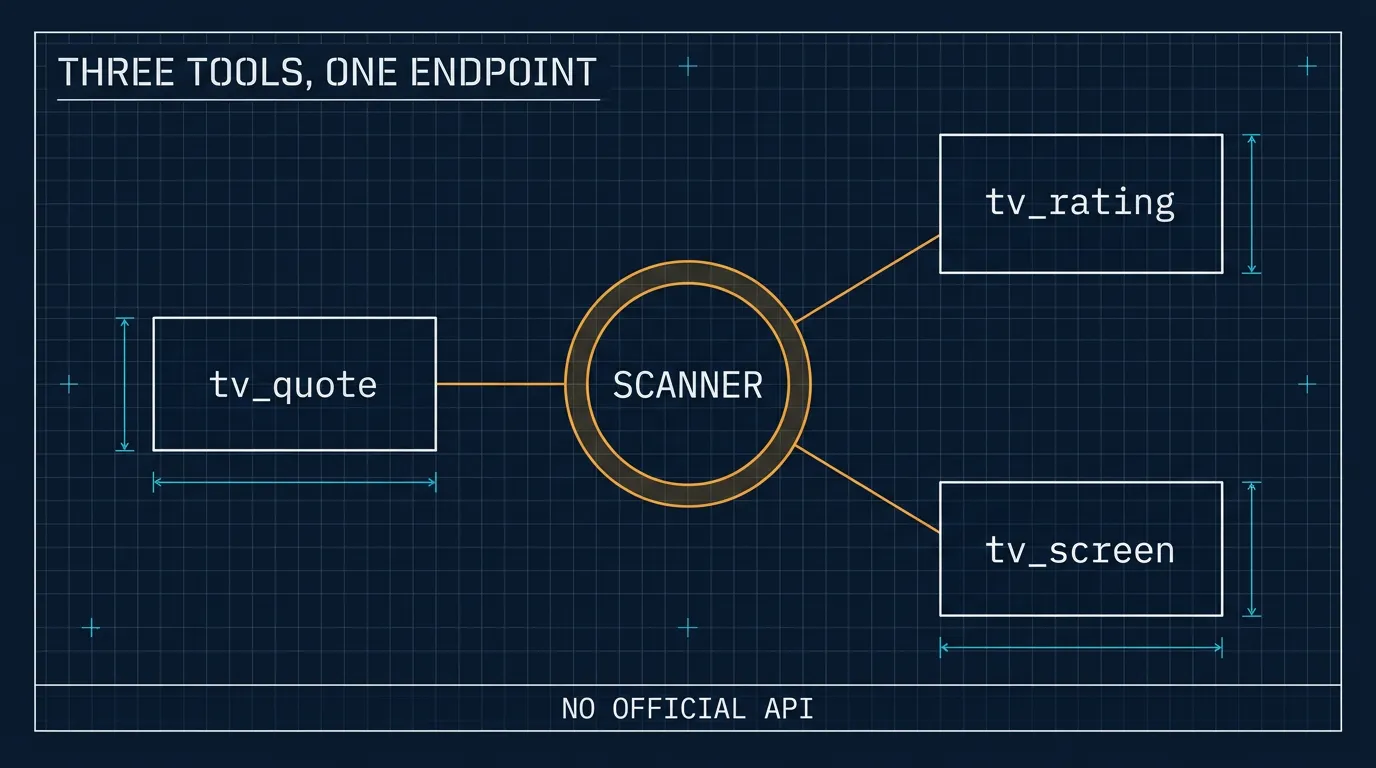
One library covers it. The scanner returns quotes, technical ratings and screening, which is everything I actually wanted — no chart drawing, no websocket, no cookies.
Three tools
| Tool | Arguments | Answers |
|---|---|---|
tv_quote | symbols, market | price, change, volume, market cap, rating |
tv_rating | symbol, interval, market | overall rating split into moving averages and oscillators |
tv_screen | filters, market, limit, sort | ”find me stocks where…” |
NASDAQ:AAPL  AAPL  348.51  -0.62  29,756,060  5.06T  0.26
NASDAQ:NVDA  NVDA  168.89  -5.47  429,273,195  4.07T  -0.51
Symbols work bare: AAPL resolves to NASDAQ:AAPL, BTC to BINANCE:BTCUSDT.
A rating runs −1 to +1. What makes it worth printing side by side is that the three columns disagree: NVDA at one point read overall −0.51, moving averages −0.93, oscillators −0.09 — the trend is down, the momentum has stopped falling. A single number hides that.
Three things the first version got wrong
Chained filters overwrite each other. A screen asking for RSI < 25 returned AAPL at RSI 55. The client’s where() replaces the filter rather than adding to it, so only the last condition survived; passing them as where(*conditions) ANDs them. The lesson generalises: a query builder that quietly keeps one condition produces plausible, wrong results — no error, just the wrong list.
type == "stock" does not mean common stock. Preferred shares such as BAC/PE and MS/PA report type: stock, and they dominated an oversold screen because preferreds trade thin and fall fast. The discriminating field is typespecs, so stock screens now add typespecs has 'common' unless you filter on it yourself, and the table says so underneath.
Numbers are not presentation. The scanner returns -0.6216316404801981. Rounding at the edge, grouping thousands, and writing market caps as 5.06T is the difference between a table a person reads and a dump.
Why an MCP and not a skill
The same question came up for the projection tool, and the answer is in the other piece: a skill teaches a procedure, an MCP adds a capability. Here the deciding factor is the filter grammar. tv_screen takes JSON with fields, operators, between, and has — as a tool schema that grammar arrives with the call and a bad field is rejected in words the model can act on. Prose in a skill would drift the first time I added a field.
The cost is honest: the three tool definitions sit in context permanently, about 670 tokens. For a tool used in most trading conversations that is cheap.
Registering it
Locally, OpenCode reads mcp.servers.<name> from its config. Two traps, both hit:
- The flat
mcp.<name>form still works and is marked deprecated in the schema; mixing both shapes in one file is how you end up debugging the copy that does nothing. - After editing the config,
opencode mcp listread the background service’s cached state and showed the old server list. The file was right the whole time. Restart the service, or check withopencode debug config, before believing a missing server.
On the Hermes VPS the shape is different: hermes mcp add <name> --command … --args …, which connects, lists the tools, and asks whether to enable them — non-interactively it cancels at that prompt, so pipe y or add the tools afterwards.
The host had no uv and no ensurepip, so the server lives in its own venv under ~/.hermes/mcp/tradingview/ with pip bootstrapped into that one directory. Nothing was installed system-wide.
What enabling it on a bot actually means
Hermes exposes each MCP server as a toolset — mcp-tradingview — and a platform gets a list of toolsets. Adding it to platform_toolsets.discord gives it to everyone in the channel, because Hermes configures tools per platform, never per user. There is no way to hand it to one member.
That is fine here: the tools read a scanner and write nothing. It does mean each member’s question spends model tokens on my account. Worth knowing before adding the next toolset.
What it does not do
No chart data — candles belong to another endpoint and a different library, and this answers “what is it doing now”, not “draw me a chart”. No watchlists, alerts, or ideas: those need a logged-in session, and cookies in a config file are another risk class. Nothing writes.
And the honest constraint: this is unofficial tooling against endpoints TradingView can change any morning. The data is theirs, the queries are for personal use, and nothing here should be redistributed.
The files
- GitHub: tradingview MCP —
server.pyand its README.
The lesson is not about TradingView. Any service without a documented API still has a shape, and the work is finding where that shape lies to you quietly.
btw, i use arch